Wednesday, April 25, 2018

We All Learn From Another ~ Who Is Your Role Model?

WE ALL LEARN FROM ANOTHER  ~  Whether Christian or secular, most often we learn from a role model or a figure of authority.  That can be a biological father or a father figure, i.e., step-father, close friend, etc. ~  or for a Christian believer, most often that role model is our pastor.  From our pastor (earthly father figure) we learn about theology, Christian relationships, and methods of doing church.

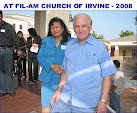
At the age of fifty, when I became a Christian believer in 1987, I found that I soon had two Christian role models in my life.  There was Pastor Sam Lacanienta who led me to the Lord, who taught me in my early Bible study endeavors, and who was always there as my pastor on Sundays and whenever my family needed him. 

Very shortly after becoming a believer, I discovered KWVE (KWave) Christian Radio (107.9 FM), the radio ministry of Calvary Chapel Costa Mesa - and found that the theology I heard on KWVE aligned well with what I was hearing in our church, the Filipino-American Church of Irvine (CA), or FACI.

Since I began my spiritual walk with the Lord under the tutelage and guidance of Pastor Sam Lacanienta - it is natural that I would be drawn to the theology he shared and his way of doing church.  Even though all Baptist churches are autonomous, the Fil-Am Church of Irvine basically got its theology and church leadership model from two sources: 

First
, Pastor Sam, who was a graduate of FEBIAS (Far Eastern Bible Institute and Seminary, later changed to FEBIAS College of Bible) - had worked in the Philippines with Far East Broadcasting Company (FEBC) in its music and teaching ministries - and had pastored a church in the Philippines before coming to America.


Secon
d, our Fil-Am Church of Irvine was and is an affiliate of the Baptist General Conference. 

The Baptist General Conference (renamed Converge in 2015) is a national association of autonomous evangelical churches that began in the Midwest in 1879.  The BGC (Converge) Baptists hold to inerrancy of the Bible, salvation by grace through faith, the necessity of the new birth, the autonomy of the local church, and believer’s baptism by immersion. 

Its Bethel Seminary was founded in 1871, is an accredited seminary with approximately 1,100 students from more than 70 denominations enrolled on campuses in St. Paul, Minnesota, San Diego, California, and its online InMinistry Distance Learning program, a blend of online and face-to-face coursework.

The BGC has remained true to its original doctrines of salvation by faith in Jesus Christ, water immersion as the only acceptable form of believer’s baptism, the inspiration and inerrancy of the Word of God, the reality of heaven and hell, and it continues to remain true to being evangelical, multi-ethnic, and committed to fulfilling the Great Commission (Matthew 28:16–20).

Over the past 30+ years that I have been a believer, I have mostly been involved in BGC affiliated Baptist churches.  On two occasions Dory and I have been involved in early start-up churches which were affiliated with the Southern Baptist Conference.  But I lean more toward the Baptist General Conference and their teachings.  Although the Southern Baptist churches are autonomous like the BGC churches, I personally find two major problems with their theology. 

First, over the past few decades, the Calvinist Movement has infiltrated the teachings of a large percentage of Southern Baptist churches - and is taught in a large number of their affiliated Seminaries.  Regardless of whether it is called "TULIP Calvinism" or "Doctrines of Grace Calvinism" - it is the same, only wearing a different euphemism hat.  And, basically I cannot find their definition of a Pre-Creation Predestination in my Bible.

And, second, many Southern Baptist churches hold to a "closed communion" where only members of that local church may receive the Lord's Supper - and I am firmly convinced that Jesus Christ meant for our symbolic remembrance of His sacrifice
(Luke 22:19-20, 1 Corinthians 11:23-25) to be done on a regular basis (most Baptist churches have communion monthly) and that it include ALL believers in the body of Christ.  I believe He would invite all His believers to join Him in the Lord's Supper - regardless of the name over the door of your church.  We are ALL told to take the Lord's Supper, together, in remembrance of Him.

We have to keep in mind that the church which was begun in the Upper Room by the Holy Spirit on the Day of Pentecost 33 AD - had no denominational name.  It was the Holy Spirit indwelled body of believers, period.  First were the 120 disciples in the Upper Room.  And within the following week it grew to over 5000 believers in Jerusalem. 

They were not Baptist, Lutheran, Methodists, Roman Catholic, etc..  They were just indwelled believers who made a decision to believe and follow Christ.  Initially, many antagonists began to call them followers of the Way.  And later, in Antioch, believers were given a derogatory name, Christians, meaning Christ followers.  Those who had rejected Him meant this as a derogatory and slanderous name - but we believers wear that name as a Crown of Glory.

At that time, if you could have asked any of those believers if they were
 Baptist, Lutheran, Methodists, Roman Catholic, etc. - they would have thought you to be deranged - for such "names" did not exist then.  And I agree with those early believers.  Don't call me by some man-created name.  Call me what I am - a Holy Spirit indwelled and sealed believer in and follower of Jesus Christ, aka, a Christian.

That is why when I am asked, I will tell folks I am a Baptist-flavored Christian believer.  Why do I describe myself that way?  Because 30+ years ago I became a believer and began studying the Bible.  And over the next few years I began to put my own personal Statement of Faith in writing, based upon my knowledge of the Bible.  Today, praise God, when I look at my personal Statement of Faith, I find that it aligns well with the General Baptist Statement of Faith.  Therefore I am a Baptist-flavored Christian believer - because I am in agreement with the Baptist Statement of Faith. 


During the years I was under the spiritual guidance of Pastor Sam Lacanienta in the Fil-Am Church of Irvine, I learned to admire him for reasons other than his theological teachings.  First, I admired the way he separated himself from the financial side of our church fellowship.   He considered himself the spiritual leader of our church - and not the financial officer.  He never got involved in the financial aspect of our church, leaving that completely to our Financial Elder, Fred Almeda. 

Pastor Sam felt strongly that he did not want to know who gave what in offerings or gifts to the church.  Why?  Well, first he considered the spiritual health of our fellowship to be more important and his main responsibility.  And, second, knowing that he has human frailties like all of us - he did not want to put himself in the position, either on purpose or inadvertently, of being more attentive to the people who gave larger offerings, than to those who gave less.  The only people in our church who knew how much, or when, a person gave - was our very discrete Financial Elder.

Pastor Sam has two rules that I believe are necessary to be a spiritual leader:  He stayed away from the financial function of our local church.  And, he would never counsel a female member without his wife, Ida, being in the same room.  He adhered firmly to these two rules - and because of that, no one could ever accuse him of any improprieties, financial or personal.

Pastor Chuck Smith at Calvary Chapel had a similar philosophy, not wanting to view people for what they gave financially - but instead relating to them spiritually.

At the Fil-Am Church of Irvine, offerings were taken by ushers quietly and somewhat discretely passing the offering plate across each row as we dropped our offering into the plate.  Then the offering plates were placed at the alter and later turned over to our Financial Elder.  A person gave as God had provided - and without fanfare or public display.

2 Corinthians 9:7-8, "So let each one give as he purposes in his heart, not grudgingly or of necessity; for God loves a cheerful giver.  And God is able to make all grace abound toward you, that you, always having all sufficiency in all things, may have an abundance for every good work."


Tithing is given as an example in the Scriptures as how individuals should respond to God's blessings.  Many individuals question whether the tithe is still applicable for believers today since we are not "under the law."  Despite that distinction, many believers consider it their privilege to give proportionately to the work of the Lord using the tithe as a pattern. 

Although churches are not given percentages in the New Testament, the principle of proportionate giving is given (1 Corinthians 16:2; 2 Corinthians 8).  The New Testament also records that the believers in the church were collecting to give to other ministries.  (Should A Church Tithe 10% Of The Offerings It Receives? - https://www.gotquestions.org/church-tithe.html)


For many years, Calvary Chapel Costa Mesa did not take pass the offering plate - preferring instead to have an offering box at the rear of the sanctuary where folks, upon entering or leaving the sanctuary, could discretely drop in their offering as the Holy Spirit led them.

Possibly the method of the offering plate and the offering box in the sanctuary comes from considering this Scripture passage. 
In the Sermon on the Mount, Jesus taught regarding the giving of alms:


Matthew 6:1-4, "Take heed that you do not do your charitable deeds before men, to be seen by them.  Otherwise you have no reward from your Father in heaven.  Therefore, when you do a charitable deed, do not sound a trumpet before you as the hypocrites do in the synagogues and in the streets, that they may have glory from men.  Assuredly, I say to you, they have their reward.  But when you do a charitable deed, do not let your left hand know what your right hand is doing, that your charitable deed may be in secret; and your Father who sees in secret will Himself reward you openly."


The context suggests that the injunction to “not let your left hand know what your right hand is doing” refers to giving alms in secret and stands in contrast with drawing attention to our giving.  Those who give in order to receive accolades from others have already received their reward (Matthew 6:2).  God will reward those who give in secret.  ("What Does It Mean That We Should Not Let Our Left Hand Know What Our Right Hand Is Doing (Matthew 6:3–4)?" -  https://www.gotquestions.org/left-hand-know-right-hand-doing.html)


I don't recall the source, but I remember reading an article written by Pastor Chuck Smith where he shared about the early days when Calvary Chapel Costa Mesa was a new and fast growing fellowship and needed to expand into a larger facility.  Pastor Chuck had found a property in Costa Mesa but did not know how they would pay for it.  He tells of how he would drive to the property in the evening, sit in his car, and pray for God to provide a way for them to buy this property to build a larger church.  History shows that God surely answered his prayers.

About that same time, he also tells of a wealthy man who offered to give the church one million dollars.  Pastor Chuck made a decision to not accept his gift.  Why?  Because one person giving a million dollars to the church - might come later seeking special favors.  He did not want Calvary Chapel under such an obligation to any person - preferring instead to allow God to bring in many smaller gifts from His people. 

And we know that God honored that prayer - for we see how Calvary Chapel, under the hand of God and with the earthly tutelage of Pastor Chuck Smith, grew from the initial sixteen member Calvary Chapel in 1965 - to the Calvary Chapel Movement of thousands of Calvary Chapel churches and Christian schools we see worldwide today.

In the book written by Pastor Chuck Smith and Tal Brooke titled "Harvest" - which is the story of the growth of Calvary Chapel Ministries I have taken these excerpts:


Calvary Chapel never asks for money.  We avoid pressuring our members for "faith pledges" - and no appeal for funds is ever made over our radio or television outreaches.  Our feeling is that begging for money brings discredit to God.  Financial integrity is central to this ministry.  So much so that all of the staff salaries are considered low by usual standards.  I limit myself and my family to a simple lifestyle, while my ministry has enabled me to oversee millions of dollars.  I want to be responsible to God for this money, for it is His money, not mine.  I am merely a steward.  This is important to me because I know that nonbelievers will be watching, and we are responsible for the way we witness to them.  (Harvest, pages 14-15)

And,


At Calvary Chapel we have confidence that when God guides, God provides - so there is never an emphasis on money or giving.  Many of our churches do not even pass the plate, but place a box at the entrance where the people who desire may contribute.  God is never represented as being broke or facing imminent bankruptcy.  The pastors have been taught that God is perfectly capable of supplying the needs for the things He desires to see accomplished.  God does not need the support of His people to stay in business, the people need the support of God.

It is sad to see people driven away from the church by the appeals and gimmicks that have been used to solicit funds.  Some have dropped out of church because they had nothing to give and felt embarrassed.  We do not let this happen to them at Calvary Chapel because they are never asked to give or to pledge.  As the apostle Paul said, never let your giving be by pressure or constraint, but let every man give as he has purposed in his own heart, for God loves a cheerful giver.  (Harvest, page 175) 


On a different but very important subject
, both Calvary Chapel and our Fil-Am Church of Irvine had an informal way of doing Bible Studies, Prayer Meetings, and Evening Services.  What developed at Calvary Chapel began in a Corona church where Chuck Smith was the pastor, before leaving to join Calvary Chapel which at that time was only sixteen members.  He tells of how that change came about:


That very night the Sunday evening church service had been unusually joyous and positive.  (Because) I stepped out and took a chance.  I departed from traditional procedure and tried something that involved everyone.  We decided to change the format from the traditional song service, announcements, prayer, and sermon to a more informal kind of a gathering. .  .  .

So having arrived early, my wife and I arranged the chairs in a circle rather than in a row.  Rather than using the hymnal, we worshiped the Lord in singing choruses.  Then we went into a time of prayer.  And many people who had been bound (in their prayer life) were able to open up and pray.  It was a very special experience for them.  And then, of course, I shared in a more informal way from the Word of God, sitting there and teaching, more as I would within an intimate home fellowship rather than the traditional church setting.  (Harvest, pages 17-18)


Pastor Chuck explains the evolution of the Bible studies and teachings methods at Calvary Chapel:


The importance of having home Bible studies was an invaluable lesson.  In these home Bible studies I developed a whole new style of teaching.  Rather than the Sunday oratory style, I would just sit and talk in a very natural way.  They (the Bible study group) would feel the freedom to interrupt when they did not understand a particular passage or interpretation of the passage, and it would turn into animated discussions. 

I found that their attention span was increased.  In church after thirty minutes of preaching people were restless.  But we could sit for an hour-and-a-half to two hours in the home and then the people would actually be disappointed that I stopped.


Later on when we started Calvary Chapel, we started several home Bible studies.  The one on Monday night was geared for the young people and I would more or less "rap" (chat) with them as we sat in the living room of a home in Costa Mesa.  The group soon became so large that we no longer fit in the home.  Kids were sitting in the dining room, kitchen, up the stairway, in the entry hall, and there would be more outside who couldn't get in.


Bill Gray Note:
  In late 1998, when Dory and I moved to Riverside County and became members of the Fil-Am Church of Corona - they had no Bible study.  I suggested to our pastor that a church without Sunday School and Bible study is like a three-legged stool with two legs missing.  Dory and I started a Bible study in our apartment and for the first couple of months the only consistent participants were Myra, Cory (pastor's wife), and pastor's two young boys.  When he could, pastor joined us. 

After a few months, others began to come - and pretty soon the Bible study outgrew our apartment and moved into Tony and Myra Alagao's home.  Over the years, that Bible study became large enough that it was split into four home Bible studies.  So, I can relate to what Pastor Chuck is telling us.


We were, at that time, building our first chapel.  The slab had been poured, so at night we would set up lights and the kids would sit on the slab and I would sit there with them.  We just built the chapel walls up around them as time went on.  It was during this time that we began to reach hundreds of the young people who had been involved in the hippie culture.  They loved the informality of sitting outside and having the teacher just sit there and talk with them rather than preach at them.


From these informal talks I developed the style of teaching in a natural, almost conversational way.  (In worship services) I just talk with the congregation about the things of God, of the glories of His nature, of His Kingdom.  I found that if I'm talking - rather than preaching - the attention span holds for an hour as they sit with open Bibles learning God's Word.  A half-hour of preaching can wear people out, but an hour of teaching, if it's done in an easy conversational way, does not.   (Harvest, pages 173-174)

Our Bible studies at FACI were very similar, a more informal lesson taught in an interactive mode.  Pastor Sam taught, but we were not allowed to just sit and listen.  He asked questions, encouraged comments, and made sure we were participants in the study - not just quiet observers. 

Later Pastor Sam, who was burdened with pastoring two churches at that time (in Irvine and in Long Beach) as well as leading four Bible studies each week - decided to assign the burden of leading our Bible studies to four of our more spiritually mature men, Elders, at FACI.  Doing that, it became obvious that the best method was to have a fully interactive Bible study where we took turns reading Scripture, verse by verse, in a passage or book, and discussing each verse or passage, as appropriate.  That same style of Bible study was adopted in each of our daughter churches which Pastor Sam planted.

In the late 1990s, Dory and I were in the hospital with the flu and being husband and wife, we were in the same room, where we had a male nurse the first few days.  When he saw me studying my Bible he asked if I was a pastor - and I assured him that was not my calling from God.  Even though he was Caucasian he was interested when I told him about our Filipino-American Baptist churches.  When he told me he lived in Long Beach and wanted to know how to find our Fil-Am Church of Long Beach - I could not give him the information he needed to find our church - and, by the next day, when I had gathered that info to give to him - he was no longer working on our floor.  I felt bad, as though I had let him and God down.

Disappointed in myself for not having that information readily available, when I got home from the hospital I made a church tract which listed all of our Fil-Am churches in Southern California.  The collage below shows the back of that tract listing full info on each of our churches.  Never again was I going to be caught being negligent, not being able to share about our churches or His Word. 

Pastor Sam and Ida Lacanienta left some 12+ years ago to follow their hearts in full time ministry in their Philippine homeland.  And since then Ida has been promoted to glory - while Pastor Sam, at 82, is still very active in ministry as pastor of the Talakag Church on the Solid Rock, Talakag, Bukidnon, Philippines, and running a Christian camp at Cagayan de Oro in Northern Mindanao, Philippines.

I recall a story I read in Our Daily Bread, Fall 1991 issue.  It was written by Henry Bosch and tells of a missionary to the Kiowa Indians.


The first missionary to the Kiowa Indians was a woman named Miss Reside.  After living with the Indians long enough for them to know what it meant to be a Christian, they began calling her "Aim Day Co."

Explaining the significance of this name, Chief Bigtree said, "When we Kiowas see anyone on the wrong trail, we call out, 'Aim day co,' which means 'Turn this way.'  Our sister came to us from a far land and found us on the wrong path and in great danger.  She stood and called to us and said, 'Turn this way.'  Then she showed us the Jesus road.  God bless Miss Aim Day Co."


The Lord Jesus declared that there are only two paths to take in life.  One is the narrow way that ascends to life eternal; the other is the broad way that descends to the pit of destruction (Matthew 7:13,14).  And He said that He is "the Way."


Jesus has not promised an easy life, the world's praise, or great material riches for following Him.  But, He richly rewards those who take the narrow road.  He forgives their sin, gives them eternal life, and assures them that they will go to heaven.


Miss "Aim Day Co" did not stay in her comfort zone; she went to where the Indians lived, she went to their comfort zone.  I'm quite sure she did not start beating them over the head with non-stop Scripture or demand that they learn her "Christianese" language.  No, I'm sure that she first learned how to tell them, in their own language, "Turn this way!  Aim day co!"


Everyone is an evangelist, a witness, an ambassador for the Lord.  With all earnestness, let's point others to Jesus.  Like Miss Aim Day Co, let's urge people, "Turn this way!"

I am eternally grateful that God has given me these very special role models as I continue in my Christian walk.  I pray that in some small way, I, too, may be able to help others find the Eternal Way.

God bless, have a wonderful, blessed day,

Bill 

Click on the image to enlarge:

Friday, April 20, 2018

"Can't Find A Church?" ~ From The Berean Call

For many years I have been receiving and reading "The Berean Call" snail-mail newsletter.  From their "About the Berean Call" web page, I found this information: 

Circa 1992, Dave Hunt (promoted to glory several years ago) and T.A. McMahon jointly founded The Berean Call organization, under the direction of Dave Hunt, for the purpose of encouraging spiritual discernment among those who regarded themselves not just as "evangelicals" but as Biblical Christians. 

The primary vehicle for this endeavor was through the publication of the newsletter "The Berean Call."  Behind every article is the exhortation to believers to get back into the Word of God instead of being “carried about by every wind of doctrine” - and to equip them with materials to help their walk in the truth.   The ministry and newsletter name is taken from Acts:17:11, where the apostle Paul admonishes us to be like the Bereans, testing the teaching and the teacher against Scripture.

Over the years I have not always agreed with them on some points of discussion - but I have gained a great deal of spiritual knowledge and understanding through reading their monthly newsletter.  The article below, from the latest issue, April 2018, is of special interest to me - for over the past 35+ years I have found myself in each of the situations described in this article.  I suspect I am not the only person who can admit to that truth.  That is why I am sharing this article with my Friends.  It might be a bit long, and made even a wee bit longer by personal comments I have inserted.  But I believe the article contains thoughts we all can relate to, in one way or another.

In sharing this article, I have reformatted it somewhat to highlight issues and points of interest which I feel we must give special consideration.  I pray that Tom McMahon will forgive me for this slight alteration.  The URL links are given below so you might know more about The Berean Call and confirm that I have not changed the wording or thoughts in this article - only changing the format to highlight some issues.

About the Berean Call:   https://www.thebereancall.org/about-berean-call

~ ~ ~ ~ ~ ~ ~ ~ ~ ~ ~ ~ ~ ~ ~ ~ ~ ~ ~ ~ ~ ~ ~ ~ ~ ~ ~ ~ ~ ~ ~ ~
 
Can't Find A Church?
T.A. McMahon, The Berean Call, April 2018 Issue
https://www.thebereancall.org/content/cant-find-church

“Dear Brothers and Sisters at The Berean Call, I’m at wit’s end.  We recently moved to a new community, and we can’t find a church that is teaching God’s Word without adding to it or subtracting from it.  Do you know of any good churches in our area?”

This is the most common request we receive here at The Berean Call, and it has been for more than two decades.  Sadly, we’ve been reluctant to recommend any specific churches, and it’s not because there aren’t any good Bible-teaching churches around.  It’s because doctrinally we don’t know where they stand today!  We’ve seen even good churches change overnight. 

The hope of this article is to give those who are presently seeking fellowship with believers who love God’s Word - and who want to grow in “the faith which was once delivered unto the saints” (Jude 3) - suggestions that we believe will be helpful in their circumstance.

Before I begin with some "suggestions" regarding what to do when looking for a church, let’s start with the qualities of a church worth seeking - in general. 

1.  The most important attribute is a church’s view of the Bible.  Do the leaders believe that Scripture is God’s inerrant communication to mankind, which was received and written down by God’s chosen prophets?  Do they believe that all the words of the Bible are inspired of God, with nothing added to them by the Scriptures’ original transcribers?

“For this cause also thank we God without ceasing, because, when ye received the word of God which ye heard of us, ye received it not as the word of men, but as it is in truth, the word of God, which effectually worketh also in you that believe” (1 Thessalonians:2:13).

Any deviation from the belief in the inerrancy of God’s Word, no matter how small, is akin to a puncture in a life raft.  At some point, sooner or later, the raft will deflate, ceasing to preserve life.

2 . A fellowship that teaches the Scriptures expositionally, i.e., verse by verse, offers a more effective situation for learning God’s Word than a church that features only topical preaching.  Certainly both approaches can be abused, but topical preaching has many inherent problems that are difficult to avoid.  Too often, topical preaching substitutes what God has said - with man’s thoughts - no matter how sincere the intention.

How does that happen? 

(1) Rarely is the correct context of the verses explained.

(2) The preacher has leeway to avoid difficult and even controversial words or passages by skipping over them.

(3) Due to the first two points above, it’s more difficult for the listener to follow the message in a Biblically discerning way as a Berean (Acts:17:10-11).

(4) It can readily take the listener away from what should be the main focus of any sermon, which is, “What is God Himself telling us directly through His Word?”

Bill Gray Note:   In my opinion, there are two reasons for a church, or pastor, to choose to avoid expositional messages (verse by verse) and use only topical messages in sermons and in Bible studies.  First, it could be that the pastor is too impatient to teach expositionally, verse by verse, through a book.  Second, and most likely the most accurate, is that the church, and/or pastor, started their ministry with a predetermined theology - which was chosen by cherry-picking specific verses/passages - and will exclude any Scripture which does not support that prechosen theology.

Teaching topically, a pastor/church, can avoid God's condemnation of specific issues, i.e., homosexuality, same-sex marriage, abortion, hell, etc.  Also, a "seeker-friendly" church might have a greater desire to fill the pews, than to share the whole truth on issues such as sin, hell, and why some folks seem to condemn themselves to hell - by denying God.

When a church/pastor teaches expositionally through the Bible - there is no way to avoid controversial issues raised in specific verses.  So those issues must be addressed honestly in the sermon message or Bible study. 


3.  Bible study programs are important.  Sometimes, when I’ve inquired among some as to whether or not they were involved in a Bible study at their church, the enthusiastic response is, “Yes!”  When I ask what book they’re studying, an all-too-common response is that they are using the latest book by a popular Christian author.

Bill Gray Note:  That became a major problem about 15 years ago when Rick Warren's 40 Weeks of Purpose Seminars were being touted in churches across America.  There was even an organization on the East Coast whose main purpose was to travel around to different churches and help organize those "40 Weeks Of Purpose" studies in the local churches.

The leader of that organization even threaten me with a lawsuit if I did not stop posting my thoughts against the
"40 Weeks of Purpose" books being used in place of the Bible, in Bible studies.  Even though I did not stop speaking out, he did not follow through, but the threat was made.  

In many churches and Bible study groups across the country - the Bible was replaced in those "Bible studies" with Rick Warren's "40 Weeks of Purpose Workbook" and his "Purpose Driven Life" book.  So, in groups who followed Rick Warren - for 40 weeks there was no reason to bring a Bible to Bible study - for it had been replaced by the Rick Warren Purpose study books. 

Dory and I were in Bible study group which we helped start in a friend's home.  One evening the leader/home owner informed us that, for the next 40 weeks (almost a year) they were going to be doing the Rick Warren "40 Weeks of Purpose" study, in lieu of the Bible study.  We left that group and found another Bible study group.  And, it happened again - twice in one year - that the Bible study we were attending decided to become a Rick Warren "40 Weeks of Purpose" study - and we had to leave once again.

Unfortunately there were even churches where the congregation split over the "40 Weeks of Purpose" activity in local churches.  Some church leaders decided to bring the Purpose Driven Program into their church studies - and that action caused the church members to divide, finally causing many to leave those churches - dividing the local church fellowship. 

According to one lady who felt the need to leave her Arkansas church fellowship, the church leaders were told by the
"40 Weeks Of Purpose" Study Training Seminar team to, "Let them go.  They are just trouble makers."   Really?  Who or what brought the dissension into that church - the fellowship members who felt the need to leave - or the "40 Weeks Of Purpose" program? 

To call that a “Bible study” is more than a misnomer, no matter how edifying the book might seem.  We need to make sure that the Bible is what’s actually being studied (in a Bible study). 

4.  Does a prospective church have a youth program that has the teaching of God’s Word as its primary objective?  Entertainment used in youth groups has ruled for decades, all but eliminating true discipleship of young people.  Paul’s words to Timothy should show us what’s valuable as a church’s youth-oriented objective:

“And that from a child thou hast known the holy Scriptures, which are able to make thee wise unto salvation through faith which is in Christ Jesus” (2 Timothy:3:15).

5.  The vital qualities of worship and the importance of serious collective prayer should also be a consideration in joining a fellowship.

Bill Gray Note:  Beware of church fellowships which promote Contemplative Prayer and other Emergent Church, New Age, and Eastern Mysticism teachings, i.e., yoga, self realization, etc.  Let me offer you excerpts from two insightful articles:

Calvary Chapel 'Parson to Parson' Position Paper
By Pastor Chuck Smith, Calvary Chapel Outreach Fellowships, Inc. (CCOF Ministry), May 2006
http://www.spiritual-research-network.com/calvary-chapel-parson-to-parson-position-paper.html

We see a tendency toward this in what is commonly called the "Emergent Church" teachings.  Some of the concerns that we have are with the speculations and positions they are suggesting:

1.  That Jesus is not the only way by which one might be saved.  It seems that they are postulating a broader gate and a broader path to heaven, a sort of "all roads lead to heaven."  (They teach) That good people of every religious persuasion may be received into heaven. 

2.  The soft peddling of hell as the destiny for those who reject the salvation offered through Jesus Christ.  There are suggestions of Universalism in their teaching - that all will ultimately be saved.

3.  We have difficulty in their touchy-feely relating to God.  Where the experience of certain feelings become the criteria for truth - rather than the Word of God.

4.  We have great problems with the use of icons to give them a sense of God or the presence of God.  If they want to have a tie with the historicity of the church, why not go back to the church in Acts - which seems to be devoid of incense, candles, robes, etc. - but was filled with the Spirit.

5.  We do not believe that we should seek to make sinners feel safe and comfortable in church.  Is it right for me to speak comforting words to a man who is going to hell unless he turns from his sin? 

6.  Should we seek to condone what God has condemned, such as the homosexual lifestyle?  Should we tell them that their problem is a genetic disorder - rather than a blatant sin that God condemns over and over in the Bible?

7.  Should we look to Eastern religions with their practices of meditation through Yoga and special breathing techniques, or repeating a mantra - to hear God speak to us? 


8.  The great confusion that exists in the divergent positions of the Emergent Church results from their challenging the final authority of the Scriptures.

There are those who say that Emergent (Church) movement has some good points, but so does a porcupine.  You are better off if you don't get too close!

So, let us not turn to our own understanding, but rather return to our own first love - and teach that the Bible is indeed the true word of God - and teach it in its entirety, nothing less and nothing more. 

And,

Calvary Chapel and Purpose Driven by Roger Oakland, Understand The Times
http://www.understandthetimes.org/commentary/c48.shtml

2. The Emerging Church


Pastor Chuck has been very outspoken regarding his concerns about the Emerging Church.  In fact in May of 2006, he sent out a letter to all Calvary Chapel pastors (Parson to Parson) stating that no Calvary Chapel pastor heading down the Emerging Church road movement would be permitted to use the name of Calvary Chapel.   In this statement he wrote:

We have great problems with the use of icons to give them (the Emerging Church) a sense of God or the presence of God.  If they want to have a tie with the historicity of the church, why not go back to the church in Acts, which seems to devoid of incense, candles, robes, etc., but was filled with the Spirit.

The letter was not only sent out to Calvary pastors to clarify the Calvary Chapel position, it was also followed up by action. Several Calvary Chapels that were once on the list of Calvary Chapel Fellowships have been removed from the list.


On the other hand, it can be documented that Rick Warren’s view of the Emergent Church is different than Chuck Smith’s view. Warren has endorsed the Emerging Church movement.  He wrote a foreword for a book written by Dan Kimball titled "The Emerging Church: Vintage Christianity for New Generations"  (Kimball is a leader in the movement).  

6.  Outreach is another significant characteristic to be weighed when selecting a church, whether that means supporting missionaries abroad or believers within the community, and sharing the witness and love of Christ in serving.

Some, especially those who’ve been actively seeking to find a “good church,” may be thinking at this point, “Great! Point me to the church with the qualities you mentioned, and I’ll be there next Sunday!”  I have little doubt that there are churches that even exceed the few things that I’ve outlined, but I also know that most don’t measure up. 

When Jesus addressed the seven churches in the first three chapters of Revelation, only two of the seven were commended without reservation.  The rest had issues that needed to be corrected, and if they didn’t comply, Jesus said, “Remember therefore from whence thou art fallen, and repent, and do the first works; or else I will come unto thee quickly, and will remove thy candlestick out of his place, except thou repent” (Revelation:2:5).  The “candlestick” is the church that is to represent the light of God’s Word, and that light is getting dimmer.  On the other hand, there are many churches today that are at least maintaining a flicker of God’s light.  But what good is that?

Someone might respond, “I’m not interested in attending a church where God’s light only flickers!”  That would be my first inclination as well.  But then, as the old saying goes, “If wishes were horses, beggars would ride.”  In other words, all the wishing in the world won’t turn the majority of churches into what has been described above.  The reality of the situation for many church-seeking believers today is that they have only “flickering churches” available to them.

Let me define what I would refer to as a flickering church.  It’s one that has overloaded its fellowship with the debris of man’s programs and practices.  But beneath that spiritually-adulterated and doctrinally-confused pile - there’s a spark of the light of Christ (the biblical Jesus) and the true Gospel.  As a veteran camper, one thing I know is that a spark found buried in the ashes of a recently used fire pit can sometimes be fanned into a flame.

Bill Gray Note:  Food for thought.  Go back and reread that paragraph above.  Is that local church more concerned with "man's programs and practices" instead of sticking to what God desires:  Worship, Fellowship, Outreach Evangelism, Prayer, Bible study - fulfilling His Great Commission?

With that in mind, here are my further suggestions when the churches in one’s community reflect little or almost none of the criteria mentioned at the beginning of this article.  When the only reasonably close churches seem repugnant to one’s Biblical sensibilities, sometimes the reaction is, “No way, Tom!  I’m not setting foot in any of those churches.  I’ll just stay at home, read my Bible, and listen to you on your Berean Call broadcasts.”

Okay, I just threw that last comment in to underscore what a bad option that is.  Reading the Bible is okay, but not doing what it says is completely counterproductive.  The Bible tells us, “Let us consider one another to provoke unto love and to good works: Not forsaking the assembling of ourselves together, as the manner of some is; but exhorting one another: and so much the more, as ye see the day approaching” (Hebrews:10:24-25).

Why would I encourage someone to set foot in a church that has multiple issues, that are of man’s making and his delusions, some of which are deceptions and seductions of the Adversary, and, all things considered, have led to much unfruitfulness as a body?  I can hear someone saying, “Dave Hunt would be rolling over in his grave if he could read this!”  I think not.  Hear me out as I give some reasons why I know Dave would support what I’m saying.

In my forty years of observing Christendom, I have witnessed the activities of the church at large (including both nominal and true believers) devolve into what is essentially a consumer operation.  Whether through the covetousness that pervades the hearts of individuals - or methods like the church-growth movement (spawned by a worldly marketing scheme), church seekers have been making decisions based primarily upon a “feed me” mentality. 

Bill Gray Note:  In the past 30+ years I have been a believer in conservative Christian churches in Southern California - I have seen many young pastors come out of seminaries supporting some level of a "church marketing program" brought from their seminary.  And, I have often wondered why they do not just let God be the "Marketing Manager" of their fellowship ~ and just concentrate on doing what He tells us in the Great Commission:  Be His witnesses, teach His Gospel, lead His local church in Godly worship and fellowship?  I believe if the pastor and the fellowship will concentrate on growing the church spiritually - God will take care of growing it numerically.

I recall a story I read some years back about two Southern California churches planted about the same time, ten miles apart.  Both churches grew quickly - and then one of them began to falter, shrinking instead of growing.  The two pastors were talking one day and Pastor Falter asked Pastor Growing, "What marketing plan have you used to build and grow your church?  I had a great marketing plan which I learned in seminary.  It worked for a while, but now it does not seem to be working.  We are losing more members than we are gaining."

Pastor Growing told him, "I have no marketing plan.  One day I was driving down the freeway and the Holy Spirit put into my heart to plant a church in that neighborhood.  So I got off the freeway to check out the area.  We started with a Bible study - and the Holy Spirit grew it from there."

There should be a lesson in that for all churches, pastors, and especially young pastors just beginning their adventure with God.

Yes, believers need to be fed, especially the Word (Luke:4:4).  But a believer’s approach to church life that’s primarily a one-way “serve me” process loses sight of the necessity of one’s own service to the body - and is missing what the Christian life is all about, not to mention the loss of the fruit and blessings that are won by selfless ministry.  It doesn’t take a terribly deep personal evaluation for any of us to recognize our own self-serving culpability.  If in doubt, check your “complaint gage” and service record concerning your involvement in your present fellowship.

What I’m getting at here - what is really necessary - is having a heart to serve.  It shouldn’t require a huge transformation for any honest person who claims to be a Biblical Christian, but fails to support the service ministries in one’s church.  If this isn’t happening in your life, you need to get back in line with what a Christian’s life in Christ is all about.  Apply that to the person (who asked the question and started this discussion) quoted at the top of this article - who doesn’t have a church and is crying out for help to find a good one.

Now, let’s consider a scenario that’s more difficult and distressing and is becoming more and more common for believers.  They have no church and no fellowship, period.  Why?  Because they disagree with all the churches they’ve visited.

If a church "holds to the Biblical Gospel and the Biblical Jesus" - even if those are buried beneath a heap of worldly teachings and programs - my recommendation is to attend that fellowship.  What?  Wouldn’t such a church lead a believer into teachings and programs that aren’t Biblically sound?  It could, but those who are struggling to find a good church very likely have enough Biblical discernment to recognize what doesn’t match up with sound doctrine.

Bill Gray Note:  If you find yourself in the situation described in the paragraph above - follow the apostle Paul's advise in Acts 17:11 and be a good Berean:  "Test the teaching and the teacher against Scripture."  And always follow Scripture.

It’s also very likely that they could be a blessing to such a church if they were to attend with a servant’s heart.  I know of a very discerning person who, when questioned as to why he decided to attend a church that offered programs that weren’t supported by Scripture, replied, “I was thinking that I might be able to help the church Biblically.”

I also know a young couple who are making a wonderful contribution to a church that probably wouldn’t allow me (Tom McMahon) to teach - given the number of programs they endorse about which I’ve written unfavorably.  Yet this couple’s ministry to young adults (involving a Bible study and personal discipleship) in the church has been praised by the leadership.  They established right up front with the leaders that when they serve within the body, the Word of God would be their guide and authority.

Their heart’s desire is to encourage young adult believers (their own peers) to learn and to apply the Scriptures in their own lives.  They don’t address the programs in the church in which they’re not in agreement, unless asked.  When that happens, their response is, “We just want to go by what the Bible says and to teach what it teaches” - and they’ve yet to receive a complaint.  They don’t want to compromise their beliefs - or be regarded as divisive. 

Others like them have this in common: they simply want to serve the body of Christ in any capacity they can, and wherever they can.  They believe that the Holy Spirit will help them to strengthen their brothers and sisters in Christ no matter how much a church has been weakened by unbiblical programs and practices.

There’s another situation regarding seeking a church, or rather not seeking, that we hear about more and more these days.  The claim is that the seekers can’t find like-minded believers in a community, so the individual or family makes the choice to isolate themselves due to their circumstance.  They end up with no church, no fellowship with other believers, no one outside themselves to serve, or with whom to pray.

They’ve shut themselves off from the diverse gifting of fellow believers for the edifying and building up of the body of Christ (1 Corinthians:12:12-27, 14:2-5, 12, 26; Ephesians:4:11-16; 1 Peter:4:10).  They rely mostly on preachers who teach over radio, TV, or other communication devices for Biblical instruction.  For these, servanthood and fellowship are among the most important components that are lost.

For believers in that detached condition, I have a few questions and thoughts.  Is it possible for the Lord to help you to find other believers?  My guess is that, among all the people attending churches in a community, there must be a potential believer, or perhaps even a true believer, or two or three.  Maybe they’re not mature in the faith but are genuinely seeking to know God in truth.  Churches, therefore, would seem to offer the best opportunity for meeting other believers in Christ.  Finding another believer (who seeks the same level of Biblical study as you) could lead to fellowship that begins by simply praying for one another.  Or it could lead to helping one another out by meeting a need. 

Eventually, it might even open the door for a Bible study.  I believe that Jesus will help those who are actively seeking fellowship to find fellowship - by His grace.  Fellowship doesn’t involve merely the comfort of being with like-minded believers, but it is the setting to best carry out the Lord’s instructions for living out the Christian life.

The last scenario is the most extreme, yet some believers are in this situation today.  It may be that, should the Lord not return soon for His bride, true believers won’t have the option of assembling together in churches.  Nevertheless, they won’t stop gathering together privately.  Why?  That’s the exhortation and the instruction for believers that is given continually throughout the New Testament.  Believers desperately need fellowship, especially as the days grow darker the nearer we get to Jesus’ return for His bride, His body.  “Now ye are the body of Christ, and members in particular” (1 Corinthians:12:27).

One among a host of instances of instruction related to the necessary interaction of the saints is 1 Thessalonians:5:11-14: “Wherefore comfort yourselves together, and edify one another, even as also ye do.   And we beseech you, brethren, to know them which labor among you, and are over you in the Lord, and admonish you; And to esteem them very highly in love for their work’s sake.  And be at peace among yourselves.  Now we exhort you, brethren, warn them that are unruly, comfort the feeble minded, support the weak, be patient toward all men.” 

All those things are best - and perhaps only - accomplished as we assemble ourselves together with brothers and sisters in obedience to our Lord and Savior.  That’s what Christ commands for our good, and for His good pleasure.

~ ~ ~ ~ ~ ~ ~ ~ ~ ~ ~ ~ ~ ~ ~ ~ ~ ~ ~ ~ ~ ~ ~ ~ ~ ~ ~ ~ ~ ~ ~ ~

I pray that in this blog you have found some "golden nuggets" of information and guidance which will help you find a local church home - or confirm that the local church home you have is where God would have you.

"And let us consider one another in order to stir up love and good works, not forsaking the assembling of ourselves together, .  .  ."  (Hebrews 10:24-25).

God bless, have a wonderful, blessed day,

Bill

Click on the image to enlarge:

Wednesday, April 18, 2018

Homosexual Activist Admits True Purpose Of Battle "IS" To Destroy Marriage - Revisit

How often have we heard from the Liberal and Secular world, "Don't be silly!  How can Same-Sex Marriage and the LGBTQ+ movement hurt you and your family?  Why don't you just mind your own business and let others love whoever they want?"

Is there truth in that statement/question?  Or is it just a sheet of Liberal Fog they are using to hide their real intention - the normalization and acceptance of any and all aberrant lifestyles?  For many years I have most certainly been witnessing a heavy fog of Liberalism rolling in across America.

Below is a blog I first posted in 2013.  And we have to admit that what was brought to light in that blog five years ago - is becoming reality today across America.  I think it is time the fog is blown away and the true intent of the Liberal Left Movement is shown in all its true anti-God, anti-American, anti-Family glory. 

That said, let me offer this Fog Warning blog for your consideration:

~ ~ ~ ~ ~ ~ ~ ~ ~ ~ ~ ~ ~ ~ ~ ~ ~ ~ ~ ~ ~ ~ ~ ~ ~ ~

Homosexual Activist Admits True Purpose Of Battle "IS" To Destroy Marriage
April 16, 2013 at 3:25pm

This morning, when I saw the article "Homosexual Activist Admits True Purpose of Battle is to Destroy Marriage" on Facebook - I was not going to share it on the TimesDaily Religion Forum. 

But since an atheist Forum Friend felt a need to share the article "Judge Rules In Favor Of Women Denied Room At Hawaii Bed And Breakfast Because They're Gay"  (http://news.yahoo.com/judge-rules-favor-lesbians-suing-130056847.html) - I felt that, in support of fair play, I should also present this Gay Activist's view of Same-Sex Marriage and the homosexual lifestyle.

Homosexual Activist Admits True Purpose Of Battle Is To Destroy Marriage
http://illinoisfamily.org/homosexuality/homosexual-activist-admits-true-purpose-of-battle-is-to-destroy-marriage/
Written By Micah Clark   |   April 6, 2013

"In 1989 Micah Clark graduated from Southwest Baptist University in Bolivar, Missouri with a bachelor’s degree in Political Science.  Micah then served as a legislative assistant for Citizens Concerned for the Constitution. He served as the Indiana Family Institute’s Director of Public Policy, and later as its Executive Director, throughout the 1990’s. In November 2001, Micah became the Executive Director of the American Family Association of Indiana."


Even knowing that there are radicals in all movements, doesn’t lessen the startling admission recently by lesbian journalist Masha Gessen.  On a radio show she actually admits that homosexual activists are lying about their radical political agenda.  She says that they don’t want to access the institution of marriage - they want to radically redefine and eventually eliminate it.


Here is what she recently said on a radio interview:

“It’s a no-brainer that (homosexual activists) should have the right to marry, but I also think equally that it’s a no-brainer that the institution of marriage should not exist. .  .  .  (F)ighting for gay marriage generally involves lying about what we are going to do with marriage when we get there — because we lie that the institution of marriage is not going to change, and that is a lie.


The institution of marriage is going to change, and it should change.  And again, I don’t think it should exist.  And I don’t like taking part in creating fictions about my life.  That’s sort of not what I had in mind when I came out thirty years ago.

I have three kids who have five parents, more or less, and I don’t see why they shouldn’t have five parents legally.  .  .  I met my new partner, and she had just had a baby, and that baby’s biological father is my brother, and my daughter’s biological father is a man who lives in Russia, and my adopted son also considers him his father. 

So the five parents break down into two groups of three.  .  .  And really, I would like to live in a legal system that is capable of reflecting that reality, and I don’t think that’s compatible with the institution of marriage.”


(Source: http://www.abc.net.au/radionational/programs/lifematters/why-get-married/4058506)

For quite some time, the defenders of natural marriage have attempted to point out that the true agenda behind the homosexual demands organizations is not marriage equality - it is the total unraveling of marriage and uprooting traditional values from society.  This will ultimately include efforts to silence and punish some churches that openly adhere to their religious teachings about marriage and sexual morality.


While few have been as vocal as this lesbian activist was in this interview, we do have numerical examples proving her point.  When given the opportunity to marry, after laws have been struck down relatively small percentages of homosexuals actually bother to marry compared to their heterosexual counterparts.

This raises question about the true need to unravel marriage for the “fair” extension (of) its benefits.  Only 12 percent of homosexuals in the Netherlands marry compared to 86 percent of their heterosexual peers.  Less than 20 percent of same-sex couples already living together in California married when given the chance in 2008.  In contrast, 91 percent of heterosexual couples in California who are living together are married.

Clearly this is about cultural change and tearing down the traditional family ethic, since it seems that most homosexuals living together neither need nor desire to marry, though they do desire to radically change marriage.

Gays and lesbians are free to live as they choose, and we live in a society which roundly applauds them doing so like never before in our history.  But they do not have the right to rewrite marriage for all of society.

As a Christian, I believe that Traditional Marriage (one man, one woman) was instituted in Genesis, the first book of the Bible.  And, once again for the record, I do not hate homosexuals and lesbians, nor does God.  I do not feel that we should relegate them to subnormal status in our society. 

BUT, I do not believe we should allow them to destroy Traditional Marriage, which has been the way of life in America for almost 400 years (from the Mayflower Compact in 1620 to today).

Homosexuality is not a Civil Right!  It is a societal desire and way of life.  Everyone in America has the same right - to marry any other willing person they desire - of the opposite sexual gender.  No, they cannot marry children.  No, they cannot marry their pet dog or sheep.  No, they cannot have multiple spouses at the same time.   That is not what was meant in these words below when, in 1620, the Mayflower Compact was written:

In the name of God, Amen.
  We, whose names are underwritten, . . .  Having undertaken, for the Glory of God, and advancements of the Christian faith, and the honor of our King and Country, a voyage to plant the first colony in the Northern parts of Virginia; do by these presents, solemnly and mutually, in the presence of God, and one another; covenant and combine ourselves together into a civil body politic; for our better ordering, and preservation and furtherance of the ends aforesaid; and by virtue hereof to enact, constitute, and frame, such just and equal laws, ordinances, acts, constitutions, and offices, from time to time, as shall be thought most meet and convenient for the general good of the colony; unto which we promise all due submission and obedience.


Those early settlers of America knew that man, left to his own desires, would corrupt our mutual society.  So, being forced by bad weather to land in Massachusetts rather than their initial destination of Virginia - the first thing they did before establishing their homes at what became Plymouth Rock, Massachusetts - was to set down a body of civic law to govern ALL people equally - not giving special privileges to a few who want to be different.

I believe that is a good rule of thumb for America today.  That we ALL live by and under the same laws and rules.  And, one of those is Traditional Marriage, the cornerstone of our American nation and society.

God bless, have a wonderful, blessed day,

Bill

Thursday, April 12, 2018

Do "YOU" Want To Be A More Effective Witness?

WHAT IS THE BEST WAY TO SHARE THE WORD OF GOD with a non-believer or a new believer?  Glad you asked.  As most of my Friends know, I believe strongly in the power of a good Bible study as a means of sharing the Gospel with the non-believer and the new believer - and it is still the best way for we who have been in Christ for a while to grow more mature in our walk with the Lord.

About 25 years ago, Dory and I became involved in a Bible study being held in our apartment community.  We had a very good leader, Bill (not me) and we both really liked his method of leading a Bible study.  We took a book of the Bible and began to read and discuss that book, verse by verse.

Let me give you an example:  As most Bible study leaders will do, since this was a new study group, Bill began in the book of John.  We began reading:

John 1:1, "In the beginning was the Word, and the Word was with God, and the Word was God."

Then we discussed that verse:  In the beginning of what?  Who is the Word?  How is the Word God?  Do you know that some people teach that the Word was "a" god and not the Triune God?

John, 1:2, "He was in the beginning with God."


If He is God, how can He be with God?  Can you explain that relationship?


As you can see, that method of leading a Bible study might take more time to get through a Scripture passage or book.  But no one will be left behind in their understanding of God's message to us in those verses.  That should be our goal - to lead folks through the salvation story and leave no one behind.

I was once left behind.  In 1991 when the Gulf War hit its peak and the oil wells in Kuwait were burning, spewing great dark clouds of smoke into the air - I am sure that inspired many, many Bible study leaders to jump into a study of the End Times Prophecies.  We had a very good Bible study leader, Tom Fletcher, and that Friday evening Tom began to talk about the Rapture, the Tribulation, etc. - and, being a relatively new believer, I had no idea what those words meant.  But, no way was I going to ask questions and show my Biblical illiteracy.  So I smiled and listened, quietly.

That evening did one thing for me.  It made me realize that End Times Prophecies must be very important to we believers, therefore I need to learn more.  So that I can intelligently join in the discussions.  That evening in 1991 began my desire to study eschatology, the End Times.  And even though I have learned a lot in the ensuing years - I still have a lot to learn. 

Yes, I have a lot to learn about eschatology - and I also have a lot to continue learning about our Christian faith.  That is why I was so excited when I found this new series of Bible study videos which take us from the basics of witnessing our faith to the non-believer and new believer - to greater maturity in our own Christian walk.

If, in your deeper studies of Scripture, you have wanted to become more knowledgeable of the Greek language of our New Testament - most likely you have found the book "Greek For The Rest Of Us, Mastering Bible Study Without Mastering Biblical Languages" by Dr. William D. Mounce.  That book has been in my personal library for many years.  And now I have found this new video series, with notes and slides available, presented by Dr. Mounce.

More information on Dr. Bill Mounce:  He is the founder and President of BiblicalTraining (dot) org, he serves on a Committee for Bible Translation, and he has written the best-selling biblical Greek textbook, "Basics of Biblical Greek," and many other Greek resources.  He blogs regularly on Greek and issues of spiritual growth.  He was also a preaching pastor - a professor of New Testament and director of the Greek Language Program at Gordon-Conwell Theological Seminary - and a professor at Azusa Pacific University.

His education background:


Ph.D. 1981, in New Testament - Aberdeen University, Aberdeen, Scotland.

M.A. 1977, in Biblical Studies - Fuller Theological Seminary, Pasadena, California.
B.A. 1975, in Biblical Studies, minor in Greek - Bethel College, St. Paul, Minnesota; Western Kentucky University, Bowling Green, Kentucky, 1971-74.  

In the first video of the series, Dr. Mounce takes the key Scripture verse, John 3:16, and breaks it down so that we all - non-believer, new believer, and more mature believer - will gain new insight into that life-promising verse.

Let's take a look at the first video titled "Conversion."

The teaching in the video follows this outline:


A. “FOR GOD SO LOVED THE WORLD”


1. Who or what is God? 

2. Why did He create the world?

3. What is our relationship with God?


B. “THAT HE GAVE HIS ONLY SON”


1. What actually happened on the cross


2. Merciful heart of God

3. Who Jesus is

C. “THAT WHOEVER BELIEVES IN HIM"


1. Whoever believes


2. Not simply “believe”

3. Believe into

4. Psalm 23

5. Salvation is not something we earn

6. Salvation is believing Jesus

D. “MIGHT NOT PERISH BUT HAVE EVERLASTING LIFE”


1.  What does it mean to have eternal life?


2.  Do you have eternal life?

E. COUNT THE COST


F. GOD’S GOAL

Video Lesson Intro:

Looking back over your conversion experience:  It’s always a good idea to look back over your conversion experience.  What do you think happened when you became a follower of Jesus Christ?  Are you unclear about anything?  Could you possibly have misunderstood anything?  Did anything happen of which you might not be aware?


https://www.biblicaltraining.org/conversion/now-i-believe
            

Or you can Watch/Download the video showing only presentation slides:

    https://vimeo.com/159970839


I pray that you will find this video series useful in your Soul Winning / Evangelism efforts - and also in your personal study of God's Word as you seek to become more mature in your Biblical knowledge and as you become a more effective witness to the lost of this world.

God bless, have a wonderful, blessed day,

Bill


Saturday, April 7, 2018

Often I Am Amazed At How God Orchestrates Events

Two weeks ago I was asked to lead an impromptu Bible study at our church.  Because of the refurbishing work being done on our new church facility, the man who was to lead the Bible study was not available - so at the last minute I was asked to lead it - and I really enjoyed it.

Last night as we were driving home from our Friday night Bible Study/Prayer Meeting, I mentioned to Dory that one of our young adult members asked me how I liked teaching the Bible study the previous week - and that I had replied, "I don't teach Bible studies - I lead them."  Dory asked, "What is the difference?"

Glad you asked.  A person who is "teaching" a Bible study typically stands before the group, often at a pulpit - and basically gives a lecture, i.e., sermon, with no interaction.  When I am "leading" a Bible study I prefer to sit with the group.  I will offer a short introduction of what we want to discuss that evening - which is typically a Scripture passage, maybe a short book in the Bible, or as we did last week I led a topical discussion on the issue of Eternal Security.  Then we will read the relevant Bible passage or passages, verse by verse, and discuss what we believe God is teaching us though His Word. 

A Bible study "leader's" main task is to get the discussion going and then encourage others to join in the dialogue.  Such a study should encourage folks to ask questions and offer comments.  That is great because it often leads us down a different avenue than we typically might follow when reading that passage.  It might be a new insight into the meaning of that Scripture passage - or it may be a dead-end tangent.  Either way we learn from the discussion.

The task of the Bible study leader - is to get folks talking about the Scripture verse just read and to get them to raise new questions and comments.  But then, the leader must keep the discussion from getting lost in a dead-end tangential thought or idea.  The "leader" must know when to encourage more comments/questions - and when to pull the dialogue back on track toward the main goal of better understanding that Scripture passage.

That was my main thought in the Facebook Note I posted in 2013 - and it is timely for the excellent Teacher, Pastor Freddy Cortez, who inspired this Facebook Note in 2013 is in the hospital this week for open-heart surgery.  So, I want to take this opportunity to ask you to lift prayers that it be God's will to return this great pastor/teacher to his pastoral and teaching ministry, where he has been so effective for the past 25+ years.


These are excerpts from that Facebook Note:


Church Of Hope, An Apostle Paul Styled Church - A Church With A Teaching Spirit!
https://www.facebook.com/notes/527491027297055/
April 7, 2013 at 11:35pm

Over the years you have seen me writing about the importance of a Christian church being a "teaching church."  Some have disagreed with me when I have said that a Christian believer gains knowledge of God's Word in this order and with this degree of learning:  Sermons (20%), Sunday Schools (40%), and Bible studies (40%).   Why do we learn so much more in Sunday Schools and Bible studies?  Because we can interact, we can discuss, we can chew on His Word, absorb His Word into our inner being (Jeremiah 15:16, Ezekiel 3:1-3).


I read somewhere, "As a baby grows by eating the proper food, so also Christians must grow by eating the Word of God."   God's Word is pure spiritual milk (1 Peter 2:2) - it is the bread of life (Matthew 4:4) - it is spirit and life (John 6:63) - and it is the knowledge that Jesus Christ is God (John 1:1).   How do we get this wonderful spiritual food?  First, by hearing it (Ephesians 1:13) through the teachings of elders and teachers (Acts 2:42) and by "chewing on it"  through active discussions found in Sunday Schools and Bible studies, private and corporate.  .  .  .


~ ~ ~ ~ ~~ ~ ~ ~ ~ ~


Bill Gray:  Hi Pastor Freddy, How many Bible studies and teaching classes do you have now at Church Of Hope?  Please bring me up to date.  I want to eat my heart out!  Thank you and God bless, Bill    (March 16 at 2:08am)

Alfredo I. Cortez Jr.:   Hi Mr. Bill, Great hearing from you as always.  I teach eight times a week.  This includes online training overseas, for our Hope Bible Institute Satellite School in Cameroon, Africa.  Pastor Teh, in Africa, is our coordinator and is doing a fantastic job hosting our studies/school.  We are finalizing our Hope Bible Institute Satellite School in the Philippines.  If all goes well, HBI Philippines will be up and running within two months.

I wish you were nearby so that you can participate in some of this.  You have always been a faithful servant of God and I trust that God continues to use you to His glory.  Thank you!  (March 16 at 10:50am)
Bill Gray Note:  The Hope Bible Institute Satellite School in the Philippines has been ongoing for several years.  And Pastor Freddy leads a Bible Conference in the Philippines once a year.

I pray that you will take a moment and read the full Facebook Note - and that it will help you in establishing your own growth pattern toward greater maturity in your knowledge of God's Word.

And, once again, please keep Pastor Freddy Cortez, his family, his church family, and his teaching ministry family in your prayers.  Let us continually be asking God to fully restore Pastor Freddy to those loved ones and students who depend upon him so much.

God bless, have a wonderful, blessed day,

Bill


Friday, April 6, 2018

Let's Talk Bibles!

In a Facebook post I made two days ago, regarding a satirical article posted on The Babylon Bee satire site - which claimed that a church in Oklahoma was so adamant about their status as a KJV-ONLY church - that the church leaders demanded that all people entering the church must have transparent covers on their Bibles.  And that way the Bible Guards at the door could ascertain if anyone was trying to sneak a non-KJV Bible into their service. 

And I suggested in my post:  The only church fellowship which I could even imagine being such a strong "KJV-ONLY Extremist" might possibly be the Westboro Baptist church in Kansas which was pastored by the late Fred Phelps, Sr. and which, under his leadership, protested all over the country with "GOD HATES - - - - " banners.

The dialogue which followed my post was productive with comments by several Christian brothers.  And, as usually happens when believers have a good discussion underway, the old adversary sends his troops in to muddy the water. 

In the discussion an old nemesis from the years I spent sharing on the TimesDaily Religion Forum, Alfred Newman (pseudonym?), raised his head and this dialogue between us pursued:

~ ~ ~ ~ ~ ~ ~ ~ ~ ~ ~ ~ ~

Alfred:  There is no "perfect translation," and the King James version may be one of the worst.  But don't let facts get in your way.

Bill Gray:  Hi Alfred Newman, My initial reaction was to ask how you, a non-believer, would know anything about the Bible.  But then I realized that most atheists are quite knowledgeable about the Bible.  Their problem is that most of them are more concerned about "self" and "I control my own life" - and do not have the spiritual discernment or desire to truly come face-to-face with Jesus Christ, God.

Some of our more productive Christians started off, like you, as atheists determined to prove God and the Bible to be false.  But, in their individual journeys of proving God wrong - they realized that He really is the Creator and that He really is in control - even for those who want to deny Him.

Good examples are:  C.S. Lewis, an atheist who became one of our most prolific Christian expositors and writers ~ and then Lee Strobel, an atheist who set out to prove God wrong and became a best selling Christian author (The Case For Christ, The Case For Faith, etc.) and a pastor.

Then there is Peter Hitchens who was an atheist like his older brother Christopher Hitchens (late world renown atheist).  Peter became a Christian and spent years publicly defending our Christian faith and debating his brother in public debates.  Sadly his brother, Christopher, died an atheist.

But, Alfred, back to your comment about Bible translations.  Is there one "perfect" Bible translation?  No.  God chose to inspire imperfect men to write His Bible, His literal revelation to man, and in doing that, He was more concerned that His inspired message, His inspired revelation, be literal and inerrant - and less concerned about the many translations.

Are there "bad" translations?  Not really.  It is just that the different translations have different tasks to perform.  Even some of the mislabeled paraphrase Bibles (The Living Bible, The Message, the Good News Bible, etc.) served a purpose.  Back in the 1960s (known as the Decadent Decade of loose morals and sexual promiscuity) and the 1970s with the secular society appearing to push the Christian faith off the edge of the world - those paraphrase Bibles were so easy to read that many who would never have jumped into a KJV, NKJV, or NASB - did begin to read the NLB and later The Message and the New Living Translation.

And God, to supplement His more accurate translations (KJV, NKJV,  NASB) - in His wisdom then gave us the Dynamic Equivalence Bible translations, NIV, etc., which convey the "thought" expressed in the source text using equivalent expressions from a contemporary language - rather than the Formal Equivalence translations
(KJV, NKJV, NASB) which give us a "word-for-word" translation which is better for an indepth study of God's Word.

So you see, my Friend, our all knowing (omniscient), all powerful (omnipotent), and omnipresent (all places present) God has given us Bible translations geared to where we are in our relationship to Him.  For the yet-to-believe there are the paraphrases - for the new believer, i.e., "babes in Christ" there are the easier to read translations, i.e., the NIV, TNIV, NLT (New Living Translation Bible), etc.  And for the more mature believers there are the KJV, the NKJV, and the NASB translations.  

Just as we do not start the child in the 1st grade off solving calculus problems - we do not start the non-believer and new "babes in Christ" off trying to understand the more accurate Formal Equivalence Bible translations.  God has chosen to work with each of us at our own level of maturity - and using flawed, imperfect men - His plan is working well.  

God bless, have a wonderful, blessed day,

Bill